Table of Content
Although untested, a pair of 4- or 5-inch rollers, where both rollers are driven to improve grip, should be more than capable of providing a suitable crush. The rollers in Chris Barnhart’s mill are made from 2-in.-diameter, cold-rolled steel, which was medium-knurled, center-drilled, and tapped to fit a bolt as a shaft. Rollers are close to those found on hobby mills, he suggests that a 4–8 in. Diameter would provide a sufficient grip on the grain with little or no texturing. Terence Tegner used a pair of smooth 6-in.-diameter rollers made of mild steel. The simple design of two-roller hobby mills makes home fabrication a reasonable possibility.
You can try using a food processor to crush grains, but any blade-style appliance may not be the best pick for keeping husks intact for brewing purposes. You could try using a coffee grinder or blender to crush your malt, but it may produce less than stellar results. Because you may not be able to adjust your grinder or blender you may end up with inconsistent grain size. Still, some have used this method and have found it to work just fine. Pulverization often happens when you are using devices such as coffee grinders and food processors to mill your grains.
Compare Products
Today, most hand sized grain mills will only produce on cup of flour at a time. Adding texture to hobby mills allows the use of a small-diameter roller that would otherwise be useless. Rollers forming an obtuse angle (small-diameter rollers) will leave the grain riding on them. Only an acute angle (large-diameter rollers) will form a sufficiently “parallel” surface to draw and crush the grain.

Not only that, but your local homebrew supply shop may even crush your malt for you. Just remember that when you try to generate power underground, you can get away with light weight fan blades and other materials. Grain mills require considerably heavier rollers that will be difficult to turn unless you add gears or other assemblies to compensate for the weight of the grain. The size of these mills will be determined by the speed and amount of water flowing in the area. Smaller mills can be operated in streams, however you will need a fast moving river if you plan to process larger amounts. Together with above ground versions, you may also want to try and create designs that utilize water pressure built up in underground pipes.
Step 5: Step 5: Test the Grain Mill
I hate when I am in the mood for a certain style of beer that I can almost taste it, only to get to the pub or tap room and they are all out of that style. As homebrewers if we want a certain style of craft beer we can have it whenever we like and we are no longer restricted to only drinking what our local brewery has on tap this week. And one of the pieces of equipment that allows us homebrewers to accomplish this is a grain mill. How great is it to be able to craft the perfect beer for your taste buds.

The precious fermentable sugars in malted barley are contained inside the husk of the kernel, and we need to expose this material for conversion. Once malted, the barley becomes quite dry and brittle and will determine whether the milled malt is going to provide the brewer with a successful grist . This is a measurement of the moisture in the kernel, and therefore its friability, or ability to be cracked open. A two-roller mill can do the job just fine in two rounds as per the gap you adjust and the crush size your desire. However, a three-roller mill would do the same in one go by passing the grain through two different gaps.
Northern Brewer Hullwrecker 2-Roller Grain Mill with Metal Base and Handle
When you build your own mill, you will also know exactly how to maintain and repair it. On the other hand, even if you purchase a very basic manual hand sized grain mill, it may have specially shaped rollers and other internal elements. In the post crisis world, you may find it difficult or impossible to replace these parts or fabricate them from materials on hand. I believe what you will find is that every homebrew system handles the grist differently during the mash and lautering. One system may get stuck sparges often and another may never get stuck sparges at all.
A pre-fabricated grain mill can get you started very quickly on developing an often forgotten homesteading skill. On the other hand, if you are on a very tight budget, it’s cheaper to take some extra time and effort to build a grain mill from scraps. While prepping, there are bound to be areas where you need to develop your skills. As discussed above, a good crush is one that produces little flour, breaks the kernels apart, and does not shred the husks.
This may result in grain beds that drink up water but don’t release wort as desired. Your local homebrew shop will likely charge a fee to crush your malt for you. Thus, you can skip the fees by doing the hard work yourself at home. Trip hammer based mills basically use a central axis that turns several hammers, each in their own turn. Here is a basic design that has been used in China for centuries.
Using internal bearings is cheaper and will also ensure that the roller spin freely and truly, as designed. A drive design provides an easy and effective way to drive both rollers. The differential speed of the rollers helps create a tangential sheering force similar to that used in commercial mills, helping to remove the husk from the endosperm. A coarser crush of well-modified malts will result in negligible loss of extraction compared with the multistep crush required by poorly modified malts to achieve similar results.
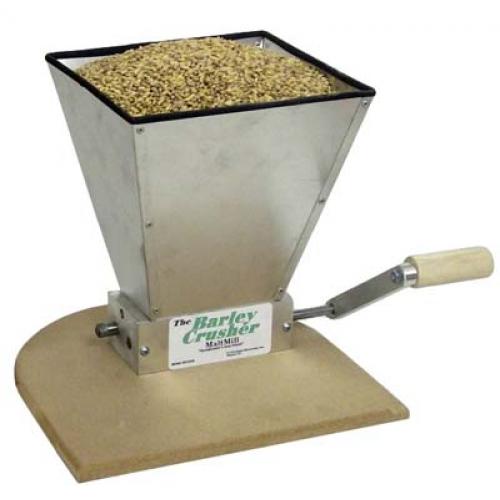
Once milled, the size of the grist particle has a huge impact on the finished beer. Ideally, each malt kernel should be cracked into three to six individual pieces, leaving the husk intact. Each homebrew grain mill has pros and cons and you can find all kinds of information on modifying the Corona and Victoria Burr Mills to do a better job. But, for most homebrewers, it is well worth the money to purchase a quality roller mill. There are a lot of brands on the market but the one I recommend, and the one I use, is TheBarley Crusher MaltMill. Because of the quality of materials, the cost-effectiveness, and the quality of the end product, your crushed grist.
By purchasing your grains whole, you can brew up something fresh whenever you feel like it. Unmilled grains also keep for much longer than grains that have already been milled. You can also study more modern designs that feature smaller hammers that can be driven by an electric motor. If you give it some thought, you will also see how to upscale these smaller designs so that they can be used with stones or other materials.
If you do some research, you will find that hand sized grain mills are some of the most popular new kitchen gadgets. As a prepper, you might be tempted to buy one or more of these grain mills and simply put them away until they are needed. Since even a hand powered grain mill can cost almost $100.00, it will be to your advantage to make your own, but here’s what you need to consider. Will Self’s design consists of two 4-in., 40-schedule PVC tubes , jockeyed into place by casters in an adjustable frame.





No comments:
Post a Comment